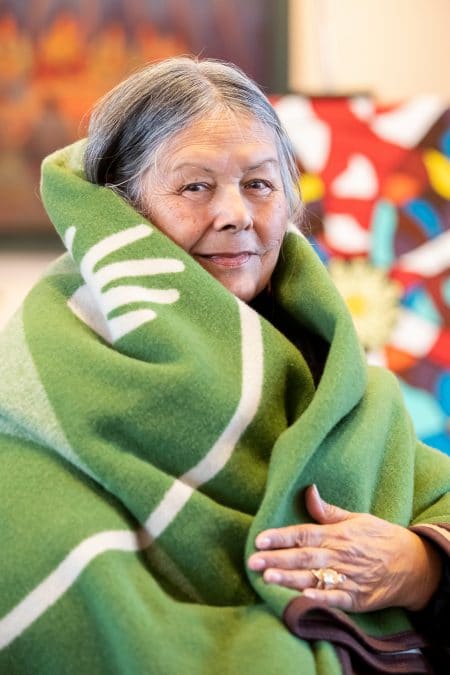
The Marianna Kistler Beach Museum of Art, located on the Kansas State University campus in Manhattan, decided to take its annual Art in
Motion series virtual in 2020 due to the coronavirus pandemic. In
November, museum curator Elizabeth Seaton organized a digital screening
of Citizen Potawatomi Nation tribal member Minisa Crumbo Halsey’s 2016
documentary, Woody Crumbo: Spirit Talk.
“It was one of the greatest experiences of my life to be able to put that together,” Crumbo Halsey said.
She served as writer, director and producer of the 44-minute movie
that delves into the inspiration and life of her father, acclaimed
Potawatomi artist Woody Crumbo. His influence and unique style continues
to influence contemporary Native American art, and Crumbo Halsey’s film
sought to celebrate and archive his work with museums and other artists
across the United States.
“Woody Crumbo was, in his work, was only about one thing, and it was
about connecting with spirit and then connecting the viewer with spirit
through the artwork,” Crumbo Halsey said in a Q&A session following
the screening. “There were no words. There was no song. And a lot of
times, people would come away from looking at the work in a very
non-verbal state.”
Inspiration
Crumbo Halsey is an avid documentary watcher, and her upbringing cultivated her fondness for the medium.
“I watch them all the time,” she said. “I like nonfiction, and I’ve
been a reader my whole life. My mother was a schoolteacher. She started
me reading early, early on. … I’ve always been very interested in
biographies, history and nonfiction.”
Her idea for the documentary came naturally in 2015, continuing what she referred to in a recent Hownikan interview as a “very creative time” in her life. Crumbo Halsey felt called to make the film, not unlike her other work.
“I feel like my father appeared to me in spirit, and he had been gone for 20 years already when I was writing (my book) Spirit Talk.
… The documentary was spirit driven. It was clear that the work that I
was doing was fine — do whatever you want. But don’t forget to do one on
your father because he’s your biggest and your best subject, and it
hasn’t been done. And, someone needs to do it,” she said.
Portraits had been a passion of hers for quite a while, and Crumbo
Halsey began interviewing people and documenting their lives with her
camera as she traveled in the early 2010s. She decided to take it
further after realizing she recorded quite a few artists and musicians
who knew her father.
“I got to thinking, ‘If I’m documenting anyone, I should be documenting my father,’” she said.
Inspiration also came from encounters with a crew for one of the
world’s most famous video documentarians, Ken Burns. While working on
the epic eight-part series Country Music for PBS, they used
office space with Crumbo Halsey’s husband, Jim Halsey. Principle writer,
producer and director Dayton Duncan interviewed him, Roy Clark, Wanda
Jackson and many other Oklahomans who have made irreplaceable
contributions to the genre throughout the last century.
“That was very rich to be around some people who just lived and breathed (making documentaries),” Crumbo Halsey said.
Burns taught her that video “eats up” still images, and she knew it
would be hard work finding enough photographs and clear shots of
paintings to tell her father’s story.
Creation as art
She contacted Tulsa’s Gilcrease Museum to search its archives for
paintings, photographs and audio recordings of her father. Woody Crumbo
worked extensively with the museum in the late 1940s and ‘50s as an
artist-in-residence and helped owner Thomas Gilcrease build his art
collection.
The Oklahoma Historical Society also provided many black-and-white
photographs, and OHS Executive Director Bob Blackburn, Ph.D., worked
with Crumbo Halsey. She found audio, news clips, images and pieces of
Crumbo’s artwork she never knew existed.
“Everyone was so gracious and so helpful about bringing things forward and making them available,” she said.
Then, she storyboarded the entire film on tables and other surfaces
around her house, laying out the images roughly in the desired order
using index cards while writing the narration. Crumbo Halsey found it
best to follow her father’s life from birth to death.
“That was my cue about what the subject matter and the text was going
to be was the timeline of the artwork — when it was done, where it was
done, who was there, what was the subject. … As a good documentary does,
it tells a story,” Crumbo Halsey said.
Choosing the music that plays throughout the film also brought many
emotions and memories. Her son, Woody Carter, wrote many of the songs,
using a sacred flute passed down from his grandfather. The movie ends
with a video of Carter performing a piece from his most recent album.
“When I got to the end, it was like it just wrapped itself up itself
and let me know what the end was — what pictures were going to be used,
what music was going to be used, what was going to be said. … It was
very interesting,” Crumbo Halsey said.
She recorded the film’s narration and then spent three to four months
with an editor, piecing it together and making her vision come to life.
Crumbo Halsey told the Beach Museum of Art webinar participants that Woody Crumbo: Spirit Talk continues to transform her and each viewing brings her to tears.
“It moves me so deeply every time that I watch it,” she said. “I
remember, I remember! And that’s exactly what the artwork is supposed to
do.”
Much of Woody Crumbo’s art depicts ceremonies, dances and traditional
stories from various tribes in places he lived throughout this life —
Cimarron, New Mexico; Tulsa, Oklahoma; La Junta, Colorado; and many
others.
“When a person paints a picture, if he has the right feeling and his
aims and all towards his depiction, if everything is alright and he is
successful, he has given that picture a spirit,” he said, in an archival
recording used in the documentary.
The creative process is more than the product — perhaps the most
crucial lesson Crumbo taught his daughter. Crumbo Halsey captured her
father’s spirit in her documentary and put more than a little of herself
in it as well.
“Being is the doing, and all life is ceremony,” she said.