Wednesday, June 30, 2021

Kansas art museum screens Citizen Potawatomi Nation member’s historical documentary

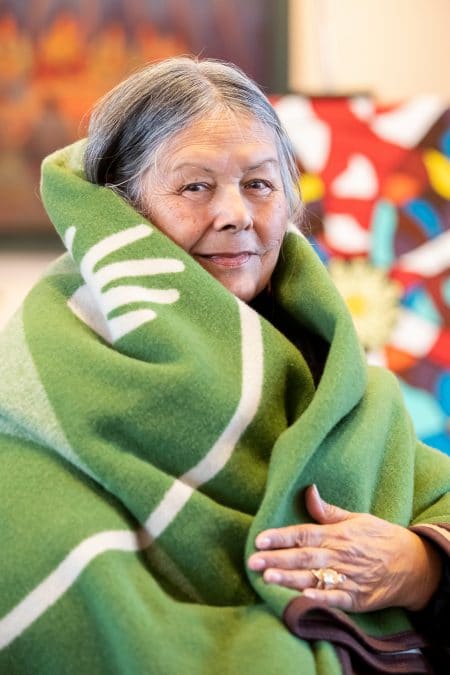
CPN artist Minisa Crumbo Halsey’s work covers
many genres and forms, including documentary film.

The Marianna Kistler Beach Museum of Art, located on the Kansas State University campus in Manhattan, decided to take its annual Art in Motion series virtual in 2020 due to the coronavirus pandemic. In November, museum curator Elizabeth Seaton organized a digital screening of Citizen Potawatomi Nation tribal member Minisa Crumbo Halsey’s 2016 documentary, Woody Crumbo: Spirit Talk.

“It was one of the greatest experiences of my life to be able to put that together,” Crumbo Halsey said.

She served as writer, director and producer of the 44-minute movie that delves into the inspiration and life of her father, acclaimed Potawatomi artist Woody Crumbo. His influence and unique style continues to influence contemporary Native American art, and Crumbo Halsey’s film sought to celebrate and archive his work with museums and other artists across the United States.

“Woody Crumbo was, in his work, was only about one thing, and it was about connecting with spirit and then connecting the viewer with spirit through the artwork,” Crumbo Halsey said in a Q&A session following the screening. “There were no words. There was no song. And a lot of times, people would come away from looking at the work in a very non-verbal state.”

Inspiration

Crumbo Halsey is an avid documentary watcher, and her upbringing cultivated her fondness for the medium.

“I watch them all the time,” she said. “I like nonfiction, and I’ve been a reader my whole life. My mother was a schoolteacher. She started me reading early, early on. … I’ve always been very interested in biographies, history and nonfiction.”

Her idea for the documentary came naturally in 2015, continuing what she referred to in a recent Hownikan interview as a “very creative time” in her life. Crumbo Halsey felt called to make the film, not unlike her other work.

“I feel like my father appeared to me in spirit, and he had been gone for 20 years already when I was writing (my book) Spirit Talk. … The documentary was spirit driven. It was clear that the work that I was doing was fine — do whatever you want. But don’t forget to do one on your father because he’s your biggest and your best subject, and it hasn’t been done. And, someone needs to do it,” she said.

Portraits had been a passion of hers for quite a while, and Crumbo Halsey began interviewing people and documenting their lives with her camera as she traveled in the early 2010s. She decided to take it further after realizing she recorded quite a few artists and musicians who knew her father.

“I got to thinking, ‘If I’m documenting anyone, I should be documenting my father,’” she said.

Inspiration also came from encounters with a crew for one of the world’s most famous video documentarians, Ken Burns. While working on the epic eight-part series Country Music for PBS, they used office space with Crumbo Halsey’s husband, Jim Halsey. Principle writer, producer and director Dayton Duncan interviewed him, Roy Clark, Wanda Jackson and many other Oklahomans who have made irreplaceable contributions to the genre throughout the last century.

“That was very rich to be around some people who just lived and breathed (making documentaries),” Crumbo Halsey said.

Burns taught her that video “eats up” still images, and she knew it would be hard work finding enough photographs and clear shots of paintings to tell her father’s story.

Creation as art

She contacted Tulsa’s Gilcrease Museum to search its archives for paintings, photographs and audio recordings of her father. Woody Crumbo worked extensively with the museum in the late 1940s and ‘50s as an artist-in-residence and helped owner Thomas Gilcrease build his art collection.

The Oklahoma Historical Society also provided many black-and-white photographs, and OHS Executive Director Bob Blackburn, Ph.D., worked with Crumbo Halsey. She found audio, news clips, images and pieces of Crumbo’s artwork she never knew existed.

“Everyone was so gracious and so helpful about bringing things forward and making them available,” she said.

Then, she storyboarded the entire film on tables and other surfaces around her house, laying out the images roughly in the desired order using index cards while writing the narration. Crumbo Halsey found it best to follow her father’s life from birth to death.

“That was my cue about what the subject matter and the text was going to be was the timeline of the artwork — when it was done, where it was done, who was there, what was the subject. … As a good documentary does, it tells a story,” Crumbo Halsey said.

Choosing the music that plays throughout the film also brought many emotions and memories. Her son, Woody Carter, wrote many of the songs, using a sacred flute passed down from his grandfather. The movie ends with a video of Carter performing a piece from his most recent album.

“When I got to the end, it was like it just wrapped itself up itself and let me know what the end was — what pictures were going to be used, what music was going to be used, what was going to be said. … It was very interesting,” Crumbo Halsey said.

She recorded the film’s narration and then spent three to four months with an editor, piecing it together and making her vision come to life.

Crumbo Halsey told the Beach Museum of Art webinar participants that Woody Crumbo: Spirit Talk continues to transform her and each viewing brings her to tears.

“It moves me so deeply every time that I watch it,” she said. “I remember, I remember! And that’s exactly what the artwork is supposed to do.”

Much of Woody Crumbo’s art depicts ceremonies, dances and traditional stories from various tribes in places he lived throughout this life — Cimarron, New Mexico; Tulsa, Oklahoma; La Junta, Colorado; and many others.

“When a person paints a picture, if he has the right feeling and his aims and all towards his depiction, if everything is alright and he is successful, he has given that picture a spirit,” he said, in an archival recording used in the documentary.

The creative process is more than the product — perhaps the most crucial lesson Crumbo taught his daughter. Crumbo Halsey captured her father’s spirit in her documentary and put more than a little of herself in it as well.

“Being is the doing, and all life is ceremony,” she said.

Monday, June 28, 2021

Excerpt from Spirit Talk:

 
Excerpt from 'Spirit Talk':

Let us now assemble the honoring gifts once again, the high and personal inner gifts of qualities which only we can know, and the gifts of the known and understood common tradition such as tobacco, water or candles; chocolate … fruits … flowers; special drinks or nectars; ritual paintings, foods, cornmeal … and gifts of inspiration and the moment … 

Notice, attention, and gratitude for ‘being breathed’; 
Gratitude to the Father Sky-Sun for return at sunrise and sunset;  
Mindful Gratitude to the water beings as we drink, see, remember or feel them … 
Mindful Gratitude to the Fire Beings … 
Speak in a friendly way to the Wind Beings … 
Talk to a stone and a tree, a shrub, and the hill in the distance … 

Open the soles of your feet and invite them to ‘pick up on’ the Mother Earth as she vibrates and breathes through our bodies and connects with the upward solar rays of her lover. They are our elemental parents. 

Go outside and lie first facedown, then turn onto your back … Draw an arm’s-length circle with a stick around you, think a little introductory offering … and sit there as unmoving as possible, except for the eyes, for at least twenty minutes … Notice and follow the breath until something else engages your attention. The natural world soon comes to accept our presence … It is best if no food/water/phone enters the circle or is in sight/smell/earshot … and the sitting is best done in complete solitude … Then, when you are ready, stand up, or crawl out, noticing which direction you entered, faced, and departed. Try to make them the same. Then, make grateful farewells, and go.

Saturday, June 26, 2021

Sacred Berries Ceremony

From May 15, 2020:
Bozho and a very good Rainy morning to all, from the Bodewadmin Longhouse🔥... an early summer, ancient and current women's teaching that can all be active within ... providing valuable focus in and on the women's seat of the soul, the woman place. A proven and worthy tool by which to live in harmony with the Creator and the natural world.
 
Migwech!
My love,
Minisa


Yes, Jaguar Woman, there IS a strawberry-demen teaching and yearlong right of passage ceremony for the young girl becoming woman. The sacred berry is representative and guardian of the life carrying qualities of the womb and the potential of 'new life coming' medicine. 
 
The other berries, which follow later in the season, represent the certain cellular division 'medicines' of the 'new life coming' and as a metaphor of the young girl becoming woman capable of 'Carrying Life and the Waters of Life'.
 
In the demen-spring or early summer ceremony she and a circle of women will pray and prepare to seek, greet, offer thanks for the gift, gather and invite the 'medicine' to join in and with, the girl's body through the coming 13 moons, at which time the demen give-away ceremony will be seated and complete, with a feast prepared for all participants.
 
Through this time, the 'young woman becoming', will observe a 13 Moon strawberry fast. She will then be offered the demen and other traditional foods, at the conclusion feast to FEED and NOURISH her life and herself, the life of the circle, her people, and ALL life, 'in a good way'.
From this time onward she will be woman, having merged with this beautiful and powerful 'medicine', assisting her transition into the beauty and responsibility of an adult woman.

Migwech Creator, Sekmekwe, Gizes and all of the Demen for these and all of the gifts, known and unknown, spoken and unspoken ... mine (and) breathed alive.

Respectfully retold, in the appropriate season.
Dawn Woman 1IK

Thursday, June 24, 2021

Conversation with Minisa Crumbo Halsey, Director of 'Woody Crumbo: Spirit Talk' (YouTube)


Join artist and filmmaker Minisa Crumbo Halsey as she responds to questions about her efforts to document the career of her father, Woodrow (Woody) Crumbo (1912-1989), a member of the Citizen Potawatomi Nation. Crumbo’s career included contributions as an artist, dancer, concert musician, arts educator, and museum administrator. During the late 1940s, he was hired to assemble the American Indian art collection for the Thomas Gilcrease Institute in Tulsa. He later became director of the El Paso Museum of Arts in Texas.

Tuesday, June 22, 2021

Getegemen - Garden

Potawatomi ‘Garden’ Vocabulary:
Basket = gokbenaben
Bees = amoyuk
Beans = koje'suk
Bloom = jijen
Butterfly = memiki
Cabbage = e'shobuk
Cherries = siwswe'mnen
Circle = waye'yak
Cloud = ngwankot
Corn = ndamen
Cucumber = kokobe'
Dance = nimedi
Drum = de'we'gIn
Earth = sugmuk
Feast = wewesnakewin
Fire = shkote'
Flint Hill Grounds = shokinkik
Flower = washkone'to
Food = wisnawen
Fruit = washkbak
Full Moon = nibakises
Garden = Getegemen
Good Rain = mnogmowIn
Gourd = shishigwIn
Grapes = siwnwen
Grass = mIshkos
Honey = amo
Hot Peppers = wasgagIn
Indian Tobacco = nInse’ma
July/Month of Young Corn = We'shkitdaminkesis
Lightning = sawasmo
Milkweed = nInwezhe’k
Moon = tpukises
Mother Earth = Kumde’kwe’
Muddy = winkiwIn
Onion = shakwesh
Outside = sagec
Peace = e’tokmite’k
Plenty Potatoes = topeka
Plum = pokma
Potatoes = pInyak
Prairie = mskoda
Pumpkin = wapkon
Purple = we'je'pwate'k
Rain = kmowen
Sage = wabshkukbyag
Spider = aspeke' e'e'buk
Stars = nagosuk
Strawberries = demen
Summer = E'mnokmuk
Sun = kises
Sunset = e'pkishmok
Sweat Lodge = mdodmogumuk
Sweet Corn = wishpumnuk
Sweetgrass = wiingaashk
Sweet Potato = wishpupnyak
Thunderbirds = cigwe’k
Toad = mamkeci
Tobacco = se’ma
Trees = mtugwe'nIn
Turtle = mshike’
Very Dark (Outside) = gispuknya
Very Light (Bright Sunshine) = waseya
Warm Wind = shawnash
Water = mbish
Watermelon = ashktamo
Well-Being = matsowIn
Whole Kernel Cooked Corn = pakswayuk
Wild = pkoc
Wild Rice = pkocnomin
Wind = notin
World = otake’
Worm = mose

Sunday, June 20, 2021

Excerpt from 'Spirit Talk':

This day we will consider visiting the natural world of the Mother Earth and the Father Sky-Sun … we 2-leggeds are walking erect color-beings … In the old honoring language … it is good to make an honoring prayer from the ‘grateful place’ … blow into an offering of tobacco 4 times, and then ‘put down’ the gift of the tobacco being, Se’-Ma’, onto the Mother Earth. Now offer honoring tobacco to the Father Sky-Sun in the same way … if it rains, consider collecting some of the ‘new water’, dip a finger into it and touch the top of your head 4 times, as the personal unification Water Beings blessing … If there is enough water, many things may be done with it, like ritually bathing the head, hair, face, body, eyes, wrists … If the wild green onions are up, make a tobacco offering from the grateful place: say your name and ask permission, and then you may take up a sharp stone for cutting or use your fingernail for gathering. Use no metal. Both the top and root bulb may be cleaned and eaten. 

Friday, June 18, 2021

Picturing the American Buffalo: George Catlin and Modern Native American Artists (SAAM)

Picturing the American Buffalo: A Conversation (SAAM)

Picturing the American Buffalo: George Catlin and Modern Native American Artists (SAAM)


'Hunting the Spirit Buffalo' by Woody Crumbo (1930s)   

Crumbo was born in Lexington, Oklahoma, the son of an Indian mother and a French father. He attended government schools as a child and showed such promise that he received a scholarship to the American Indian Institute in Wichita for his last two years of high school. While at the Institute, he became interested in expressing Indian tradition and culture through his art. After three years at the University of Wichita he transferred to the University of Oklahoma where he studied with Oscar B. Jacobson. At the early age of 21, Crumbo was appointed Director of Indian Art at Bacone College, the only institute of higher learning exclusively for Indians. Bacone offered Crumbo the unique opportunity to familiarize himself with his heritage and to instill in him cultural pride. At that time he conducted research into Indian design and revived ancient techniques of silverwork, vegetable dying, and weaving.

Crumbo’s career has been diverse; known also as a musician and Indian ceremonial dancer, Crumbo played the cedar wood flute and danced with Thurlow Lieurance’s symphony in Wichita. He also worked as a designer with the Douglas Corporation, with the Gilcrease Collection in Tulsa, and from 1960 to 1968 as curator of the El Paso Museum of Art.

A Pottawatomie Indian, Crumbo explores in his art the traditions and ceremonies of his own tribe as well as those of the Creek, Sioux, and Kiowa nations, and says of his work, ​I have always painted with the desire of developing Indian art so that it may be judged on art standards rather on its value as a curio—I am attempting to record Indian customs and legends now, while they are alive, to make them a part of the great American culture before these, too, become lost, only to be fragmentarily pieced together by fact and supposition.

Crumbo works in oil and egg tempera, as well as in watercolor, sculpture, stained glass, and silkscreen. Under the guidance of Olle Nordmark, he also learned etching. The largest collection of Crumbo’s work, about 175 paintings, is owned by the Gilcrease Museum in Tulsa, although his work has been exhibited in many museums throughout the United States.

Virginia Mecklenburg The Public as Patron: A History of the Treasury Department Mural Program (College Park, Maryland: University of Maryland, n.d.)

Wednesday, June 16, 2021

Panel: Native American Perspectives (YouTube)

From: February 27, 2020
Online Exhibition: Voices of the West


A closer look at historic and contemporary Native American imagery in the museum's Voices of the West exhibition (2020). Guest speakers are Norman Akers (Osage), Lauren Ritterbush, and Minisa Crumbo Halsey (Citizen Potawatomi Nation and Muscogee).

Monday, June 14, 2021

Kansas art museum screens Citizen Potawatomi Nation member’s historical documentary

CPN artist Minisa Crumbo Halsey’s work covers
many genres and forms, including documentary film.

The Marianna Kistler Beach Museum of Art, located on the Kansas State University campus in Manhattan, decided to take its annual Art in Motion series virtual in 2020 due to the coronavirus pandemic. In November, museum curator Elizabeth Seaton organized a digital screening of Citizen Potawatomi Nation tribal member Minisa Crumbo Halsey’s 2016 documentary, Woody Crumbo: Spirit Talk.

“It was one of the greatest experiences of my life to be able to put that together,” Crumbo Halsey said.

She served as writer, director and producer of the 44-minute movie that delves into the inspiration and life of her father, acclaimed Potawatomi artist Woody Crumbo. His influence and unique style continues to influence contemporary Native American art, and Crumbo Halsey’s film sought to celebrate and archive his work with museums and other artists across the United States.

“Woody Crumbo was, in his work, was only about one thing, and it was about connecting with spirit and then connecting the viewer with spirit through the artwork,” Crumbo Halsey said in a Q&A session following the screening. “There were no words. There was no song. And a lot of times, people would come away from looking at the work in a very non-verbal state.”

Inspiration

Crumbo Halsey is an avid documentary watcher, and her upbringing cultivated her fondness for the medium.

“I watch them all the time,” she said. “I like nonfiction, and I’ve been a reader my whole life. My mother was a schoolteacher. She started me reading early, early on. … I’ve always been very interested in biographies, history and nonfiction.”

Her idea for the documentary came naturally in 2015, continuing what she referred to in a recent Hownikan interview as a “very creative time” in her life. Crumbo Halsey felt called to make the film, not unlike her other work.

“I feel like my father appeared to me in spirit, and he had been gone for 20 years already when I was writing (my book) Spirit Talk. … The documentary was spirit driven. It was clear that the work that I was doing was fine — do whatever you want. But don’t forget to do one on your father because he’s your biggest and your best subject, and it hasn’t been done. And, someone needs to do it,” she said.

Portraits had been a passion of hers for quite a while, and Crumbo Halsey began interviewing people and documenting their lives with her camera as she traveled in the early 2010s. She decided to take it further after realizing she recorded quite a few artists and musicians who knew her father.

“I got to thinking, ‘If I’m documenting anyone, I should be documenting my father,’” she said.

Inspiration also came from encounters with a crew for one of the world’s most famous video documentarians, Ken Burns. While working on the epic eight-part series Country Music for PBS, they used office space with Crumbo Halsey’s husband, Jim Halsey. Principle writer, producer and director Dayton Duncan interviewed him, Roy Clark, Wanda Jackson and many other Oklahomans who have made irreplaceable contributions to the genre throughout the last century.

“That was very rich to be around some people who just lived and breathed (making documentaries),” Crumbo Halsey said.

Burns taught her that video “eats up” still images, and she knew it would be hard work finding enough photographs and clear shots of paintings to tell her father’s story.

Creation as art

She contacted Tulsa’s Gilcrease Museum to search its archives for paintings, photographs and audio recordings of her father. Woody Crumbo worked extensively with the museum in the late 1940s and ‘50s as an artist-in-residence and helped owner Thomas Gilcrease build his art collection.

The Oklahoma Historical Society also provided many black-and-white photographs, and OHS Executive Director Bob Blackburn, Ph.D., worked with Crumbo Halsey. She found audio, news clips, images and pieces of Crumbo’s artwork she never knew existed.

“Everyone was so gracious and so helpful about bringing things forward and making them available,” she said.

Then, she storyboarded the entire film on tables and other surfaces around her house, laying out the images roughly in the desired order using index cards while writing the narration. Crumbo Halsey found it best to follow her father’s life from birth to death.

“That was my cue about what the subject matter and the text was going to be was the timeline of the artwork — when it was done, where it was done, who was there, what was the subject. … As a good documentary does, it tells a story,” Crumbo Halsey said.

Choosing the music that plays throughout the film also brought many emotions and memories. Her son, Woody Carter, wrote many of the songs, using a sacred flute passed down from his grandfather. The movie ends with a video of Carter performing a piece from his most recent album.

“When I got to the end, it was like it just wrapped itself up itself and let me know what the end was — what pictures were going to be used, what music was going to be used, what was going to be said. … It was very interesting,” Crumbo Halsey said.

She recorded the film’s narration and then spent three to four months with an editor, piecing it together and making her vision come to life.

Crumbo Halsey told the Beach Museum of Art webinar participants that Woody Crumbo: Spirit Talk continues to transform her and each viewing brings her to tears.

“It moves me so deeply every time that I watch it,” she said. “I remember, I remember! And that’s exactly what the artwork is supposed to do.”

Much of Woody Crumbo’s art depicts ceremonies, dances and traditional stories from various tribes in places he lived throughout this life — Cimarron, New Mexico; Tulsa, Oklahoma; La Junta, Colorado; and many others.

“When a person paints a picture, if he has the right feeling and his aims and all towards his depiction, if everything is alright and he is successful, he has given that picture a spirit,” he said, in an archival recording used in the documentary.

The creative process is more than the product — perhaps the most crucial lesson Crumbo taught his daughter. Crumbo Halsey captured her father’s spirit in her documentary and put more than a little of herself in it as well.

“Being is the doing, and all life is ceremony,” she said.

Saturday, June 12, 2021

Excerpt from Spirit Talk:

 
Excerpt from 'Spirit Talk':

Let us now assemble the honoring gifts once again, the high and personal inner gifts of qualities which only we can know, and the gifts of the known and understood common tradition such as tobacco, water or candles; chocolate … fruits … flowers; special drinks or nectars; ritual paintings, foods, cornmeal … and gifts of inspiration and the moment … 

Notice, attention, and gratitude for ‘being breathed’; 
Gratitude to the Father Sky-Sun for return at sunrise and sunset;  
Mindful Gratitude to the water beings as we drink, see, remember or feel them … 
Mindful Gratitude to the Fire Beings … 
Speak in a friendly way to the Wind Beings … 
Talk to a stone and a tree, a shrub, and the hill in the distance … 

Open the soles of your feet and invite them to ‘pick up on’ the Mother Earth as she vibrates and breathes through our bodies and connects with the upward solar rays of her lover. They are our elemental parents. 

Go outside and lie first facedown, then turn onto your back … Draw an arm’s-length circle with a stick around you, think a little introductory offering … and sit there as unmoving as possible, except for the eyes, for at least twenty minutes … Notice and follow the breath until something else engages your attention. The natural world soon comes to accept our presence … It is best if no food/water/phone enters the circle or is in sight/smell/earshot … and the sitting is best done in complete solitude … Then, when you are ready, stand up, or crawl out, noticing which direction you entered, faced, and departed. Try to make them the same. Then, make grateful farewells, and go.

Thursday, June 10, 2021

Sacred Berries Ceremony

From May 15, 2020:

Bozho and a very good Rainy morning to all, from the Bodewadmin Longhouse🔥... an early summer, ancient and current women's teaching that can all be active within ... providing valuable focus in and on the women's seat of the soul, the woman place. A proven and worthy tool by which to live in harmony with the Creator and the natural world.
 
Migwech!
My love,
Minisa


Yes, Jaguar Woman, there IS a strawberry-demen teaching and yearlong right of passage ceremony for the young girl becoming woman. The sacred berry is representative and guardian of the life carrying qualities of the womb and the potential of 'new life coming' medicine. 
 
The other berries, which follow later in the season, represent the certain cellular division 'medicines' of the 'new life coming' and as a metaphor of the young girl becoming woman capable of 'Carrying Life and the Waters of Life'.
 
In the demen-spring or early summer ceremony she and a circle of women will pray and prepare to seek, greet, offer thanks for the gift, gather and invite the 'medicine' to join in and with, the girls body through the coming 13 moons, at which time the demen give-away ceremony will be seated and complete, with a feast prepared for all participants.
 
Through this time, the 'young woman becoming', will observe a 13 Moon strawberry fast. She will then be offered the demen and other traditional foods, at the conclusion feast to FEED and NOURISH her life and the herself, the life of the circle, her people, and ALL life, 'in a good way'.
From this time onward she will be woman, having merged with this beautiful and powerful 'medicine', assisting her transition into the beauty and responsibility of an adult woman.

Migwech Creator, Sekmekwe, Gizes and all of the Demen for these and all of the gifts, known and unknown, spoken and unspoken ... mine (and) breathed alive.

Respectfully retold, in the appropriate season.
Dawn Woman 1IK

Tuesday, June 8, 2021

Conversation with Minisa Crumbo Halsey, Director of 'Woody Crumbo: Spirit Talk' (YouTube)


Join artist and filmmaker Minisa Crumbo Halsey as she responds to questions about her efforts to document the career of her father, Woodrow (Woody) Crumbo (1912-1989), a member of the Citizen Potawatomi Nation. Crumbo’s career included contributions as an artist, dancer, concert musician, arts educator, and museum administrator. During the late 1940s, he was hired to assemble the American Indian art collection for the Thomas Gilcrease Institute in Tulsa. He later became director of the El Paso Museum of Arts in Texas.

Saturday, June 5, 2021

Picturing the American Buffalo: George Catlin and Modern Native American Artists (SAAM)

Picturing the American Buffalo: A Conversation (SAAM)

Picturing the American Buffalo: George Catlin and Modern Native American Artists (SAAM)


'Hunting the Spirit Buffalo' by Woody Crumbo (1930s)   

Crumbo was born in Lexington, Oklahoma, the son of an Indian mother and a French father. He attended government schools as a child and showed such promise that he received a scholarship to the American Indian Institute in Wichita for his last two years of high school. While at the Institute, he became interested in expressing Indian tradition and culture through his art. After three years at the University of Wichita he transferred to the University of Oklahoma where he studied with Oscar B. Jacobson. At the early age of 21, Crumbo was appointed Director of Indian Art at Bacone College, the only institute of higher learning exclusively for Indians. Bacone offered Crumbo the unique opportunity to familiarize himself with his heritage and to instill in him cultural pride. At that time he conducted research into Indian design and revived ancient techniques of silverwork, vegetable dying, and weaving.

Crumbo’s career has been diverse; known also as a musician and Indian ceremonial dancer, Crumbo played the cedar wood flute and danced with Thurlow Lieurance’s symphony in Wichita. He also worked as a designer with the Douglas Corporation, with the Gilcrease Collection in Tulsa, and from 1960 to 1968 as curator of the El Paso Museum of Art.

A Pottawatomie Indian, Crumbo explores in his art the traditions and ceremonies of his own tribe as well as those of the Creek, Sioux, and Kiowa nations, and says of his work, ​I have always painted with the desire of developing Indian art so that it may be judged on art standards rather on its value as a curio—I am attempting to record Indian customs and legends now, while they are alive, to make them a part of the great American culture before these, too, become lost, only to be fragmentarily pieced together by fact and supposition.

Crumbo works in oil and egg tempera, as well as in watercolor, sculpture, stained glass, and silkscreen. Under the guidance of Olle Nordmark, he also learned etching. The largest collection of Crumbo’s work, about 175 paintings, is owned by the Gilcrease Museum in Tulsa, although his work has been exhibited in many museums throughout the United States.

Virginia Mecklenburg The Public as Patron: A History of the Treasury Department Mural Program (College Park, Maryland: University of Maryland, n.d.)

Thursday, June 3, 2021

Panel: Native American Perspectives (YouTube)

From: February 27, 2020
Online Exhibition: Voices of the West


A closer look at historic and contemporary Native American imagery in the museum's Voices of the West exhibition (2020). Guest speakers are Norman Akers (Osage), Lauren Ritterbush, and Minisa Crumbo Halsey (Citizen Potawatomi Nation and Muscogee).

Tuesday, June 1, 2021

Kansas art museum screens Citizen Potawatomi Nation member’s historical documentary

CPN artist Minisa Crumbo Halsey’s work covers
many genres and forms, including documentary film.

The Marianna Kistler Beach Museum of Art, located on the Kansas State University campus in Manhattan, decided to take its annual Art in Motion series virtual in 2020 due to the coronavirus pandemic. In November, museum curator Elizabeth Seaton organized a digital screening of Citizen Potawatomi Nation tribal member Minisa Crumbo Halsey’s 2016 documentary, Woody Crumbo: Spirit Talk.

“It was one of the greatest experiences of my life to be able to put that together,” Crumbo Halsey said.

She served as writer, director and producer of the 44-minute movie that delves into the inspiration and life of her father, acclaimed Potawatomi artist Woody Crumbo. His influence and unique style continues to influence contemporary Native American art, and Crumbo Halsey’s film sought to celebrate and archive his work with museums and other artists across the United States.

“Woody Crumbo was, in his work, was only about one thing, and it was about connecting with spirit and then connecting the viewer with spirit through the artwork,” Crumbo Halsey said in a Q&A session following the screening. “There were no words. There was no song. And a lot of times, people would come away from looking at the work in a very non-verbal state.”

Inspiration

Crumbo Halsey is an avid documentary watcher, and her upbringing cultivated her fondness for the medium.

“I watch them all the time,” she said. “I like nonfiction, and I’ve been a reader my whole life. My mother was a schoolteacher. She started me reading early, early on. … I’ve always been very interested in biographies, history and nonfiction.”

Her idea for the documentary came naturally in 2015, continuing what she referred to in a recent Hownikan interview as a “very creative time” in her life. Crumbo Halsey felt called to make the film, not unlike her other work.

“I feel like my father appeared to me in spirit, and he had been gone for 20 years already when I was writing (my book) Spirit Talk. … The documentary was spirit driven. It was clear that the work that I was doing was fine — do whatever you want. But don’t forget to do one on your father because he’s your biggest and your best subject, and it hasn’t been done. And, someone needs to do it,” she said.

Portraits had been a passion of hers for quite a while, and Crumbo Halsey began interviewing people and documenting their lives with her camera as she traveled in the early 2010s. She decided to take it further after realizing she recorded quite a few artists and musicians who knew her father.

“I got to thinking, ‘If I’m documenting anyone, I should be documenting my father,’” she said.

Inspiration also came from encounters with a crew for one of the world’s most famous video documentarians, Ken Burns. While working on the epic eight-part series Country Music for PBS, they used office space with Crumbo Halsey’s husband, Jim Halsey. Principle writer, producer and director Dayton Duncan interviewed him, Roy Clark, Wanda Jackson and many other Oklahomans who have made irreplaceable contributions to the genre throughout the last century.

“That was very rich to be around some people who just lived and breathed (making documentaries),” Crumbo Halsey said.

Burns taught her that video “eats up” still images, and she knew it would be hard work finding enough photographs and clear shots of paintings to tell her father’s story.

Creation as art

She contacted Tulsa’s Gilcrease Museum to search its archives for paintings, photographs and audio recordings of her father. Woody Crumbo worked extensively with the museum in the late 1940s and ‘50s as an artist-in-residence and helped owner Thomas Gilcrease build his art collection.

The Oklahoma Historical Society also provided many black-and-white photographs, and OHS Executive Director Bob Blackburn, Ph.D., worked with Crumbo Halsey. She found audio, news clips, images and pieces of Crumbo’s artwork she never knew existed.

“Everyone was so gracious and so helpful about bringing things forward and making them available,” she said.

Then, she storyboarded the entire film on tables and other surfaces around her house, laying out the images roughly in the desired order using index cards while writing the narration. Crumbo Halsey found it best to follow her father’s life from birth to death.

“That was my cue about what the subject matter and the text was going to be was the timeline of the artwork — when it was done, where it was done, who was there, what was the subject. … As a good documentary does, it tells a story,” Crumbo Halsey said.

Choosing the music that plays throughout the film also brought many emotions and memories. Her son, Woody Carter, wrote many of the songs, using a sacred flute passed down from his grandfather. The movie ends with a video of Carter performing a piece from his most recent album.

“When I got to the end, it was like it just wrapped itself up itself and let me know what the end was — what pictures were going to be used, what music was going to be used, what was going to be said. … It was very interesting,” Crumbo Halsey said.

She recorded the film’s narration and then spent three to four months with an editor, piecing it together and making her vision come to life.

Crumbo Halsey told the Beach Museum of Art webinar participants that Woody Crumbo: Spirit Talk continues to transform her and each viewing brings her to tears.

“It moves me so deeply every time that I watch it,” she said. “I remember, I remember! And that’s exactly what the artwork is supposed to do.”

Much of Woody Crumbo’s art depicts ceremonies, dances and traditional stories from various tribes in places he lived throughout this life — Cimarron, New Mexico; Tulsa, Oklahoma; La Junta, Colorado; and many others.

“When a person paints a picture, if he has the right feeling and his aims and all towards his depiction, if everything is alright and he is successful, he has given that picture a spirit,” he said, in an archival recording used in the documentary.

The creative process is more than the product — perhaps the most crucial lesson Crumbo taught his daughter. Crumbo Halsey captured her father’s spirit in her documentary and put more than a little of herself in it as well.

“Being is the doing, and all life is ceremony,” she said.