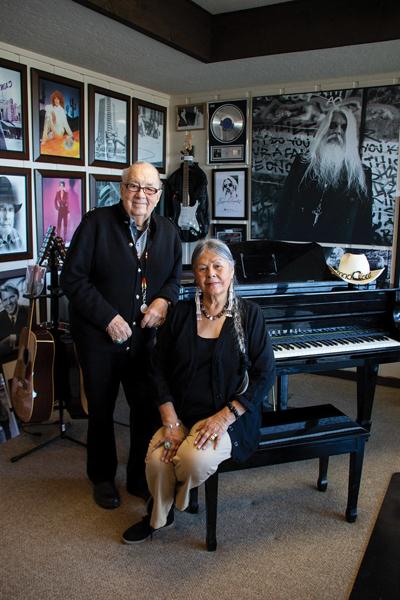
LEGENDS: Jim Halsey and Minisa Crumbo
(
Tulsa People Feb. 2020)
Jim Halsey has booked, managed and promoted country music talent
since the age of 18, and after 70 years in the music business, he shows
no signs of slowing down. His career has taken him to every state and
nearly every country while guiding and advising for global acts such as
Roy Clark, the Oakridge Boys and Oklahoma’s Reba McEntire.
Meanwhile,
his wife of 40 years, Minisa Crumbo, has become a star in her own
right, as an internationally known artist skilled in painting,
silversmithing, photojournalism and teaching. Crumbo is a member of the
Citizen Potawatomi Nation and the Muscogee (Creek) Nation, whose ties to
the earth and its energy reflect the creativity she and Halsey share.
Where did you go to school/university? Why?
Jim:
I grew up in Independence, Kansas, and went to high school there. My
bio says I studied at the University of Kansas, but I didn’t study
anywhere. I just went there. Then I went to Independence Community
College, and by the time I was finished with that, I was well into the
business of promoting.
Minisa: I grew up in Taos,
New Mexico, and went to high school at Wasatch Academy boarding school
in Mt. Pleasant, Utah. I attended college at the University of Texas at
El Paso. My interest was history, but I didn’t graduate.
Do you remember the first concert you promoted?
Jim:
I remember all of them. The very first gig was in October of 1949. It
was a Tulsa band, Leon McCullough and his western swing band, which was
very popular back in those days. He performed at the Memorial Hall in
Independence. They just recently named the Memorial Hall auditorium the
Jim Halsey Auditorium.
How did you build your business?
Jim:
I just started from there. I was successful in marketing in college. My
family had a department store, so I knew all about reaching the
customer with a good product.
I’ve been very blessed with great
family, friends and a company. It’s not just what I’ve done. I employed
42 people and had five offices in L.A., New York, Nashville, here and
London — it’s the cumulative work of all of those people together in the
Jim Halsey Co.
What do you call yourself — a booking agent, a manager?
Jim: An impresario. That includes it all. Developing an artist is the most stimulating and creative thing I do.
What would you say was the peak of your career in the music industry?
Jim: I haven’t been there yet.
How long do you plan to keep up your busy schedule?
Jim: I’m going to keep doing it until I get it right.
When did you move to Tulsa?
Jim:
Tulsa has always been home base, but we’ve lived in other places. We
didn’t live very long in Nashville. We’ve had homes in Taos, New Mexico;
Santa Fe; Santa Monica; Malibu; and here. I moved to Tulsa in 1970.
What do you enjoy most about this business?
Jim:
Changing people’s lives. I like not only changing people from a good
performer to a certain element of success, but I like watching people in
an audience. People who have come in there and maybe have some family
problem at home or not enough money to pay the rent, or a sickness. For
two hours, a good entertainer can transform that person to another
element of peace and harmony.
Does a good entertainer have that certain spark?
Jim:
They have to have it or they’re not a good entertainer. Anybody can get
up and sing, but if you’ll notice my list of people — each one had
something special that nobody else had. That’s what I look for.
What was one of your defining moments in life?
Jim:
I’ve had a lot of them, but the biggest change in my life came when we
took country music, Roy Clark and the Oakridge Boys, to the Soviet Union
for the first time in 1976. Those were dark, dank and dismal times,
right in the middle of the Cold War. There was animosity and hard
feelings on both sides. Roy and the Oakridge Boys went over there and
did 21 sold-out concerts. Those people came in with almost a hostile
attitude toward Americans. They were skeptical and frightened we were
going to bomb them any moment. From the very first concert they warmed
up that audience, and by the time we left the Soviet Union 21 days
later, there were positive articles about us everywhere. It was a
life-changing experience for me because I really saw the power behind a
good, honest, wholesome performance to change people’s lives. For two
hours, they sat there and yelled and screamed and applauded. We changed
their lives.
What age do you feel right now and why?
Jim: I have no idea. I don’t even think about it. I just live day to day. Thank you, God.
Minisa: I feel like today is the first day of the rest of my life because I live in the eternal present.
What would people be surprised to know about you?
Jim:
The dedication I have for what I do. It’s not entertainment, it’s not
music, it’s not art. It’s about our lives — the way we live it — and the
spiritual energy we can gather from the earth.
If you could witness any event of the past, present or future, what would it be?
Jim: Peace and harmony in the world.
What was a “worst time” and how did you pull through it?
Jim:
When my daughter, Gina, was diagnosed with leukemia. I’m happy to talk
about it today because 40 years ago she went into remission. She’s still
here, thanks to a whole talented group of doctors — one in particular,
Alan Keller. At that time, the survival rate for leukemia was about 5%,
but we had the support of family, friends, great doctors and a spiritual
belief. What pulled her through was not only great doctors but her
strong beliefs.
What concerns you today?
Jim: Too many cell phones.
How do you measure success?
Jim: By accomplishments and what you can do to help other people.
Minisa: Maintaining conscious communication with the Creator.
What is a favorite Tulsa memory?
Jim: Watching “Mezeppa” on KOTV.
Minisa: Serving as a docent at Gilcrease Museum.
Describe a perfect weekend in Tulsa or elsewhere.
Jim:
Staying home, my wife fixing one of her great meals. We live in the
country, so it’s very peaceful and I enjoy that. Where we live used to
be our ranch where we did big, extravagant parties. It was called Circle
R Ranch. There was a group of us who owned it: Roy Clark, myself, Hank
Thompson, Wayne Creasey. We had people from all over the world who would
visit, and we had artists perform. It was by invitation only. We had
maybe 2,500 guests and a big barbecue. It wasn’t a blatant sales
opportunity, but we sold millions of dollars worth of entertainment in
that one-day weekend. We usually ran it in conjunction with the Roy
Clark Celebrity Golf Tournament.
Everybody who was anybody in the entertainment business was there.
Minisa: Working in the yard.
What do you miss the most in Tulsa?
Jim: Zingo!
What are the most significant changes you’ve experienced?
Jim:
I think the Kaiser people have really made the difference with
Gathering Place, the Woody Guthrie Center, the Bob Dylan Archives —
they’ve made it an intellectual center for music and entertainment.
Minisa:
Probably the development of the River Parks, but I also miss my
parents. They were Oklahoma people. Dad was a close friend to Thomas
Gilcrease, and I was born here. I miss them not being here.
What attracted you to each other? How do your areas of creativity intersect?
Jim:
I think it’s the creative, positive energy that she has. The art is
just one expression of that, but that comes from in here (heart) but
it’s kind of in both of our lives. The first thing I tell any artist
that I’m involved with is don’t believe your press and PR because before
you know it, you’re going to believe that you’re a lot more important
and a lot more talented than you really are. You have to remain in your
heart who you are.
I feel that I’m creative, but we do feed off of
each other with creative energy. Because we do have a separate vibe, so
to speak, that we pick up on. She helps me enormously.
It’s that
form of companionship that becomes a soul matter, a spirit matter.
Besides the physical attraction, which is the very least of it, it’s the
fact of our communication between each other. I met her at an art show
here in Tulsa. I’d always been a big fan of her dad’s art. Her dad was
Woody Crumbo, a resident artist at Gilcrease. She’s a teacher for me as
well as a loving companion and probably the most fantastic cook that
I’ve known anywhere. Everything Julia Child could’ve cooked she can do
better.
Minisa: We just allow one another to be who we are.
What would you say is your favorite artform?
Minisa: Life is long. I’ve done a lot of wonderful things. I’m riveted by every single thing. I love the creative aspects of life.
Where does your inspiration come from?
Minisa:
Creation springs from the mind of God. Everything is imbued with life
and therefore inspires creativity. I really don’t create in my artwork
as much as I interpret. I interpret my response to whatever it is I’m
working with. Whether it’s cooking, the garden or ceremony, everything
is defined by the form and function it’s working through.
What projects are you working on for 2020?
Minisa:
I have a long-term planning exhibition that I’m working on with the
Citizen Potawatomi Band to present a women’s arts collective exhibition
at our next annual gathering of the bands in Hannahville, Michigan, in
late July.