Thursday, October 28, 2021

Kansas art museum screens Citizen Potawatomi Nation member’s historical documentary

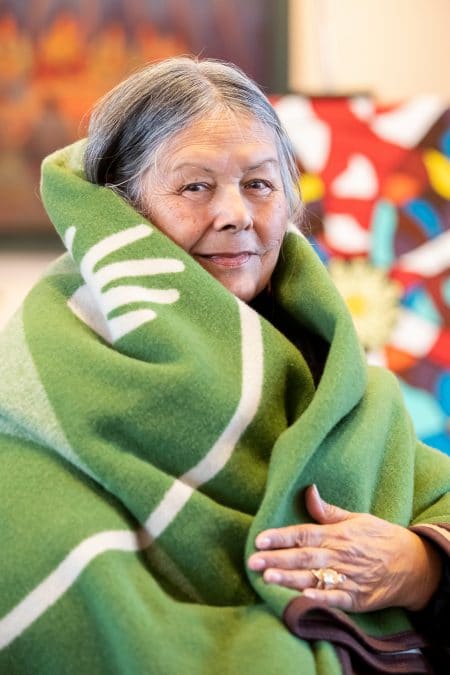
CPN artist Minisa Crumbo Halsey’s work covers
many genres and forms, including documentary film.

The Marianna Kistler Beach Museum of Art, located on the Kansas State University campus in Manhattan, decided to take its annual Art in Motion series virtual in 2020 due to the coronavirus pandemic. In November, museum curator Elizabeth Seaton organized a digital screening of Citizen Potawatomi Nation tribal member Minisa Crumbo Halsey’s 2016 documentary, Woody Crumbo: Spirit Talk.

“It was one of the greatest experiences of my life to be able to put that together,” Crumbo Halsey said.

She served as writer, director and producer of the 44-minute movie that delves into the inspiration and life of her father, acclaimed Potawatomi artist Woody Crumbo. His influence and unique style continues to influence contemporary Native American art, and Crumbo Halsey’s film sought to celebrate and archive his work with museums and other artists across the United States.

“Woody Crumbo was, in his work, was only about one thing, and it was about connecting with spirit and then connecting the viewer with spirit through the artwork,” Crumbo Halsey said in a Q&A session following the screening. “There were no words. There was no song. And a lot of times, people would come away from looking at the work in a very non-verbal state.”

Inspiration

Crumbo Halsey is an avid documentary watcher, and her upbringing cultivated her fondness for the medium.

“I watch them all the time,” she said. “I like nonfiction, and I’ve been a reader my whole life. My mother was a schoolteacher. She started me reading early, early on. … I’ve always been very interested in biographies, history and nonfiction.”

Her idea for the documentary came naturally in 2015, continuing what she referred to in a recent Hownikan interview as a “very creative time” in her life. Crumbo Halsey felt called to make the film, not unlike her other work.

“I feel like my father appeared to me in spirit, and he had been gone for 20 years already when I was writing (my book) Spirit Talk. … The documentary was spirit driven. It was clear that the work that I was doing was fine — do whatever you want. But don’t forget to do one on your father because he’s your biggest and your best subject, and it hasn’t been done. And, someone needs to do it,” she said.

Portraits had been a passion of hers for quite a while, and Crumbo Halsey began interviewing people and documenting their lives with her camera as she traveled in the early 2010s. She decided to take it further after realizing she recorded quite a few artists and musicians who knew her father.

“I got to thinking, ‘If I’m documenting anyone, I should be documenting my father,’” she said.

Inspiration also came from encounters with a crew for one of the world’s most famous video documentarians, Ken Burns. While working on the epic eight-part series Country Music for PBS, they used office space with Crumbo Halsey’s husband, Jim Halsey. Principle writer, producer and director Dayton Duncan interviewed him, Roy Clark, Wanda Jackson and many other Oklahomans who have made irreplaceable contributions to the genre throughout the last century.

“That was very rich to be around some people who just lived and breathed (making documentaries),” Crumbo Halsey said.

Burns taught her that video “eats up” still images, and she knew it would be hard work finding enough photographs and clear shots of paintings to tell her father’s story.

Creation as art

She contacted Tulsa’s Gilcrease Museum to search its archives for paintings, photographs and audio recordings of her father. Woody Crumbo worked extensively with the museum in the late 1940s and ‘50s as an artist-in-residence and helped owner Thomas Gilcrease build his art collection.

The Oklahoma Historical Society also provided many black-and-white photographs, and OHS Executive Director Bob Blackburn, Ph.D., worked with Crumbo Halsey. She found audio, news clips, images and pieces of Crumbo’s artwork she never knew existed.

“Everyone was so gracious and so helpful about bringing things forward and making them available,” she said.

Then, she storyboarded the entire film on tables and other surfaces around her house, laying out the images roughly in the desired order using index cards while writing the narration. Crumbo Halsey found it best to follow her father’s life from birth to death.

“That was my cue about what the subject matter and the text was going to be was the timeline of the artwork — when it was done, where it was done, who was there, what was the subject. … As a good documentary does, it tells a story,” Crumbo Halsey said.

Choosing the music that plays throughout the film also brought many emotions and memories. Her son, Woody Carter, wrote many of the songs, using a sacred flute passed down from his grandfather. The movie ends with a video of Carter performing a piece from his most recent album.

“When I got to the end, it was like it just wrapped itself up itself and let me know what the end was — what pictures were going to be used, what music was going to be used, what was going to be said. … It was very interesting,” Crumbo Halsey said.

She recorded the film’s narration and then spent three to four months with an editor, piecing it together and making her vision come to life.

Crumbo Halsey told the Beach Museum of Art webinar participants that Woody Crumbo: Spirit Talk continues to transform her and each viewing brings her to tears.

“It moves me so deeply every time that I watch it,” she said. “I remember, I remember! And that’s exactly what the artwork is supposed to do.”

Much of Woody Crumbo’s art depicts ceremonies, dances and traditional stories from various tribes in places he lived throughout this life — Cimarron, New Mexico; Tulsa, Oklahoma; La Junta, Colorado; and many others.

“When a person paints a picture, if he has the right feeling and his aims and all towards his depiction, if everything is alright and he is successful, he has given that picture a spirit,” he said, in an archival recording used in the documentary.

The creative process is more than the product — perhaps the most crucial lesson Crumbo taught his daughter. Crumbo Halsey captured her father’s spirit in her documentary and put more than a little of herself in it as well.

“Being is the doing, and all life is ceremony,” she said.

Tuesday, October 26, 2021

Panel: Native American Perspectives (YouTube)

From: February 27, 2020
Online Exhibition: Voices of the West


A closer look at historic and contemporary Native American imagery in the museum's Voices of the West exhibition (2020). Guest speakers are Norman Akers (Osage), Lauren Ritterbush, and Minisa Crumbo Halsey (Citizen Potawatomi Nation and Muscogee).

Sunday, October 24, 2021

Picturing the American Buffalo: George Catlin and Modern Native American Artists (SAAM)

Picturing the American Buffalo: A Conversation (SAAM)

Picturing the American Buffalo: George Catlin and Modern Native American Artists (SAAM)


'Hunting the Spirit Buffalo' by Woody Crumbo (1930s)   

Crumbo was born in Lexington, Oklahoma, the son of an Indian mother and a French father. He attended government schools as a child and showed such promise that he received a scholarship to the American Indian Institute in Wichita for his last two years of high school. While at the Institute, he became interested in expressing Indian tradition and culture through his art. After three years at the University of Wichita he transferred to the University of Oklahoma where he studied with Oscar B. Jacobson. At the early age of 21, Crumbo was appointed Director of Indian Art at Bacone College, the only institute of higher learning exclusively for Indians. Bacone offered Crumbo the unique opportunity to familiarize himself with his heritage and to instill in him cultural pride. At that time he conducted research into Indian design and revived ancient techniques of silverwork, vegetable dying, and weaving.

Crumbo’s career has been diverse; known also as a musician and Indian ceremonial dancer, Crumbo played the cedar wood flute and danced with Thurlow Lieurance’s symphony in Wichita. He also worked as a designer with the Douglas Corporation, with the Gilcrease Collection in Tulsa, and from 1960 to 1968 as curator of the El Paso Museum of Art.

A Pottawatomie Indian, Crumbo explores in his art the traditions and ceremonies of his own tribe as well as those of the Creek, Sioux, and Kiowa nations, and says of his work, ​I have always painted with the desire of developing Indian art so that it may be judged on art standards rather on its value as a curio—I am attempting to record Indian customs and legends now, while they are alive, to make them a part of the great American culture before these, too, become lost, only to be fragmentarily pieced together by fact and supposition.

Crumbo works in oil and egg tempera, as well as in watercolor, sculpture, stained glass, and silkscreen. Under the guidance of Olle Nordmark, he also learned etching. The largest collection of Crumbo’s work, about 175 paintings, is owned by the Gilcrease Museum in Tulsa, although his work has been exhibited in many museums throughout the United States.

Virginia Mecklenburg The Public as Patron: A History of the Treasury Department Mural Program (College Park, Maryland: University of Maryland, n.d.)

Friday, October 22, 2021

Excerpt from 'Spirit Talk':

 
Excerpt from 'Spirit Talk':

Let us now assemble the honoring gifts once again, the high and personal inner gifts of qualities which only we can know, and the gifts of the known and understood common tradition such as tobacco, water or candles; chocolate … fruits … flowers; special drinks or nectars; ritual paintings, foods, cornmeal … and gifts of inspiration and the moment … 

Notice, attention, and gratitude for ‘being breathed’; 
Gratitude to the Father Sky-Sun for return at sunrise and sunset;  
Mindful Gratitude to the water beings as we drink, see, remember or feel them … 
Mindful Gratitude to the Fire Beings … 
Speak in a friendly way to the Wind Beings … 
Talk to a stone and a tree, a shrub, and the hill in the distance … 

Open the soles of your feet and invite them to ‘pick up on’ the Mother Earth as she vibrates and breathes through our bodies and connects with the upward solar rays of her lover. They are our elemental parents. 

Go outside and lie first facedown, then turn onto your back … Draw an arm’s-length circle with a stick around you, think a little introductory offering … and sit there as unmoving as possible, except for the eyes, for at least twenty minutes … Notice and follow the breath until something else engages your attention. The natural world soon comes to accept our presence … It is best if no food/water/phone enters the circle or is in sight/smell/earshot … and the sitting is best done in complete solitude … Then, when you are ready, stand up, or crawl out, noticing which direction you entered, faced, and departed. Try to make them the same. Then, make grateful farewells, and go.

Wednesday, October 20, 2021

The All-Important Craft Table!

I feel this message (below) is a creative and valuable one for each of us as we pray for endurance in these challenging times of remembering ourselves and at the same time, forging new heart pathways forward. 


Good morning, Jaguar Woman!

Here I am, taking a break to watch Saturday morning cooking shows but I want to share the making of a lightening color theme tobacco bag. 

The northeast woodland traditional overlay applique technique is used ... a cross body shoulder strap with lightening color satin ribbon tassels will go on next. The design is a stylized flower and leaf in the northeast woodland motif.

It is constructed of cotton, lined, light weight and meant to hug the body, while at the ready to make a muluc offering while on a walk, morning sun ceremony, or making a faerie garden sit. Could be almost anything inside. The Traditional name for these are ‘possibles bags’. Don’t you love it? The larger bag, carried by both men and women is called a bandolier.

At the top right is a pile of self-dyed indigo silk and cotton. I had thought to use this, and shall, when the vision becomes more clear.

You are SO right when you say,”Do something creative ... and it almost doesn’t matter what it is.” And so, by these ways do we find and see the beauty of ourselves while carrying all manner of known and unknown possible magic at hand.

Migwech for your work, today's and every day's inspirational message. They make my heart feel good.

Dawn Woman


Excerpt from 'Spirit Talk':

This day we will consider visiting the natural world of the Mother Earth and the Father Sky-Sun … we 2-leggeds are walking erect color-beings … In the old honoring language … it is good to make an honoring prayer from the ‘grateful place’ … blow into an offering of tobacco 4 times, and then ‘put down’ the gift of the tobacco being, Se’-Ma’, onto the Mother Earth. Now offer honoring tobacco to the Father Sky-Sun in the same way … if it rains, consider collecting some of the ‘new water’, dip a finger into it and touch the top of your head 4 times, as the personal unification Water Beings blessing … If there is enough water, many things may be done with it, like ritually bathing the head, hair, face, body, eyes, wrists …

Monday, October 18, 2021

Spirit Talk Musical Workshop (MONAH)

Sunrise Song Lyrics and Translation

Morning Song Video (Starts @ 32 min.)

MINISA CRUMBO HALSEY:  Born in Tulsa, Oklahoma in the Year of the Earth Horse, to Lillian Hogue Crumbo and Woodrow Wilson Crumbo. I am Muscogee Creek and Potawatomi Indian, Scots-Irish from my maternal Papa and French-German from my paternal Papa.

My education, in the ways of the Mother Earth and the Father Sky-Sun, who were and remain my first, most important and beautiful teachers, is grounded in the black jack hills of Oklahoma and the high mountain valleys of New Mexico. As a child in Sand Springs, OK, as I laid on the grass and looked up into the starry night sky, an airplane flew over and I said, "I want to go there". And so it has been. The natural world is my University.

The floor around Woody Crumbo's drawing table, my maternal grandmother Harriett Hogue's garden, milk cow and wood cook stove, my mother and first school teacher, Lillian Crumbo's kindergarten class at the Taos Pueblo Day School ... These places were where I would receive the first structured life lessons, lessons that would endure and reverberate endlessly to this day.

I am an artist and craftsperson of several disciplines: painting, silversmithing, basketry, potting, as well as quilting, cooking, gardening and writing. I am currently working on THE BOOK OF EARTH DAYS, which includes original illustrations and poetry.

It is a Medicine Wheel Teachings book, offering to accompany the reader through an honoring and interactive 'medicine' journey through a 12 month-13 Moon Calendar period, as it emanates from the mind of the Creator as a teaching of natural wisdom and nourishing element to the minds, hearts, bodies and Spirits of all Beings that live upon and within our beautiful Mother Earth and Father Sky Sun.

I am married to Jim Halsey, Impressario Extraordinaire.

I have two beautiful and talented children, Woodrow Rexford Carter; pilot and Tesla scholar, father and husband, of Prescott, AZ., Christine Heather Carter Rumford; wife, mother, skier and award winning realtor, of Vail, CO.

Woody Crumbo was a long time friend and admirer of the Koshare Indian Dancers Founder, Francis 'Buck', Burshears. In the 1970's Buck, Jane and 'Ma' Burshears invited the Crumbo's to move from Taos, New Mexico to La Junta, CO where they made their home for a number of years. Here, Woody maintained a studio and Lillian taught in the La Junta public schools. Both Lillian and Woody Crumbo were enthusiastic supporters of the internationally recognized and accomplished Koshare Indian Dancers.

Woody Crumbo, and many, many other dedicated and specialized teachers, mentors, interested friends and sponsors, mothers and fathers, spent much time with 'the boys', discussing varied Native American traditions and broader American and Universal ideals, lecturing in art appreciation, studying dance, face and body 'paint', song, drumming, regalia understandings and construction and appropriate deportment as representatives of the Koshare Indian Dancer tradition. It was and remains to be a vast and complex organization that requires committed input and participation from a myriad of persons and directions to function smoothly, efficiently and with satisfaction for both the core performing Koshare Indian Dancer organization and the attending public.

In the midst of this microcosm of the Universe, they spoke of and considered: the arts, vision and aspirations, interactive and cooperative actions, focusing on the desirable, appropriate and attainable goals as identified by and within Buck's vision for 'his boys'. Within this microcosm they worked, laughed, sweated together, forging life long alliances, and growing into manhood while striving to incorporate and maintain the Boy Scouts of America ideals, teachings and traditions, high grade point averages in school and then, they danced their hearts out in the Kiva and on tour. And so, the Natural World and helpers, continued(s) to teach, inspire and support brilliant and inspired lives as they move out from their Kiva, the teaching and ceremonial place of what it means to truly be a Human Being and into their larger lives in the World.

Woody Crumbo painted SPOTTED WOLF'S LAST REQUEST in the La Junta, CO studio and it was subsequently acquired for the Koshare Indian Museum, where it hangs on display today.

It is my very great pleasure to serve on the Board. I consider it an honor to carry on in the Crumbo-Koshare tradition. Would that their days measure many and joyful.

Saturday, October 16, 2021

Spirit Talk Musical Workshop w/Minisa Crumbo Halsey

Spirit Talk Musical Workshop (Starts @ 19 min.)

Sunrise Song Lyrics and Translation

Morning Song Video (Starts @ 32 min.)

'Bozho Nikon, hello, my bone

My name is Minisa Crumbo. I am an enrolled member of the Citizen Potawatomi Nation of Oklahoma. As an artist, homemaker, and elder I invite you to come and sit with us at this gathering of people, generously coordinated and hosted by MONAH. Chi migwech, thank you MONAH for this opportunity. I am honored.

We are being called together not only to celebrate life but more seriously, to intentionally formulate sacred conversations and to consider learning some personal honoring ceremonies based on seasonal Medicine Wheel Teachings. These talks, while interactive, are still valid, two-way conversations of a sacred nature even while being conducted in the etheric realm.

By these WAYS, may we continue to grow in awareness and personal connection with ourselves, others, the natural world, and prime Creator that we may forge tools to begin putting an end to ‘that which is not real. By such WAYS do we endeavor to grow in wisdom, knowledge, bravery, honesty, and love. May we be drawn together, to even begin forging a shared vision and to begin bonding in ways of positive evolution and emergence, as the sacred beings that we are and know ourselves to be.

We are in a new morning of the world ... let us endeavor to take up the staff of our shared divinity. It’s okay to cry now. Let us all cry for new vision and renewed energy and the good health by which to make these things real ...

And so, we come alive for another day ... or anytime, for we live in the 'eternal present'.

Peace, love, and joy be with each one of us, now and forevermore. AHO!'